
Your Reactions Are Not the Enemy
There is a strange pressure in modern self-development to become someone who no longer reacts.
Someone calm. Someone unshakable. Someone who watches life happen with perfect composure.
It sounds enlightened. Until you realize that nothing living behaves that way.
Forests react to drought. Birds react to storms. Skin reacts to warmth. A healthy nervous system is constantly responding to reality, adjusting itself to what is actually happening.
Life is responsiveness.
What quietly destroys perception is something much subtler. It’s the moment when our reactions stop teaching us anything.
The same argument. The same resentment. The same attraction. The same withdrawal. The same explanation.
Every reaction carries information before it carries emotion.
Anger often arrives before a boundary becomes conscious. Jealousy may reveal a neglected longing before it becomes comparison. Grief usually recognizes a truth long before the mind is willing to speak it aloud. Fear can point toward genuine danger—or toward an ancient pattern that has mistaken familiarity for safety.
The reaction itself is rarely the destination. It’s an unopened letter.
Most people spend enormous amounts of energy trying not to feel these reactions, or trying to justify them. Both approaches quietly discard the information they contain.
Over time, perception becomes flatter. The world begins to look repetitive. People seem to keep disappointing us in exactly the same ways. Life feels like an endless loop.
But perhaps the loop isn’t outside us. Perhaps we’re simply refusing to read the letters life keeps delivering.
Something remarkable happens when a reaction is allowed to complete its work. It stops needing to repeat itself. Because it has finally been heard.
The goal isn’t emotional perfection. It’s becoming someone whose experience can still teach them.
Every genuine reaction is an invitation to recover another fragment of perception. Whether we accept the invitation is what shapes the next version of reality we become capable of seeing.
dive deeper with volume VIII of living systems
〰️
dive deeper with volume VIII of living systems 〰️
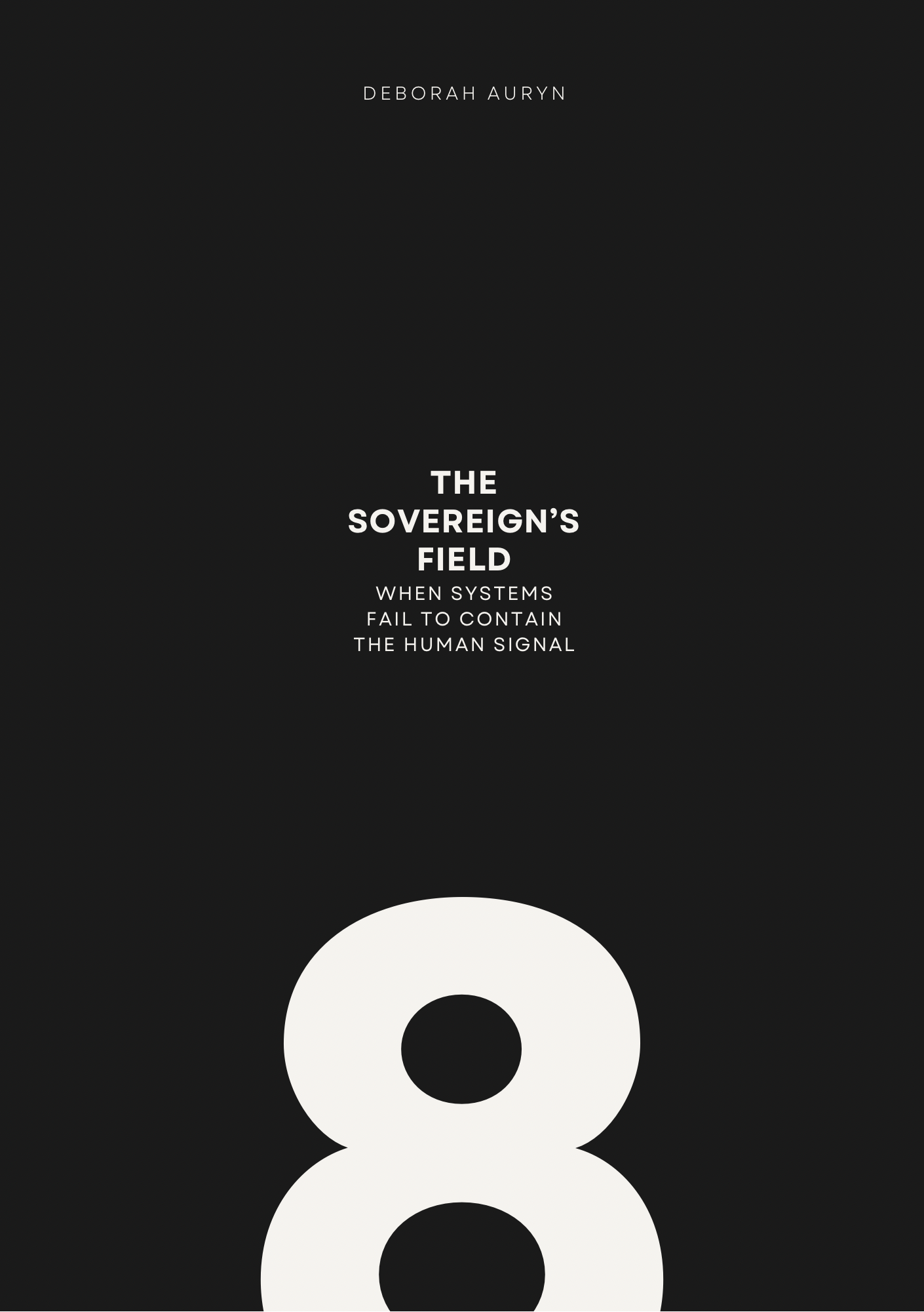
What if “the field” is not an escape from systems — but evidence of systemic failure?
What if spaciousness appears when imposed structures can no longer successfully organize perception?
And what happens when people interpret that rupture as freedom… without understanding the mechanisms that produced it?
Inside this volume you find:
The difference between sovereignty and withdrawal
Why systems collapse at the level of perception before behavior
How coherence becomes inaccessible inside structurally incoherent environments
The mechanics of suppression, over-adaptation, and perceptual distortion
Why most modern “alignment” frameworks fail under pressure
Boundary integrity as feedback regulation, not performance
The hidden cost of optimization-based communication
Why people mistake silence for transcendence
The relationship between agency, consequence, and behavioral consistency
How systems train humans away from perceiving reality directly
A coherent system does not require fragmentation in order to function.
And a human being should not have to disappear
in order to remain intelligible inside reality.
That is the threshold this work investigates.
Digital Edition (PDF)
Immediate download upon purchase (non-refundable).
For readers investigating:
systems • agency • coherence • suppression • perception • structural design • feedback dynamics • human livability
Read slowly. Test against lived experience. Retain your own signal.