 Image 1 of 1
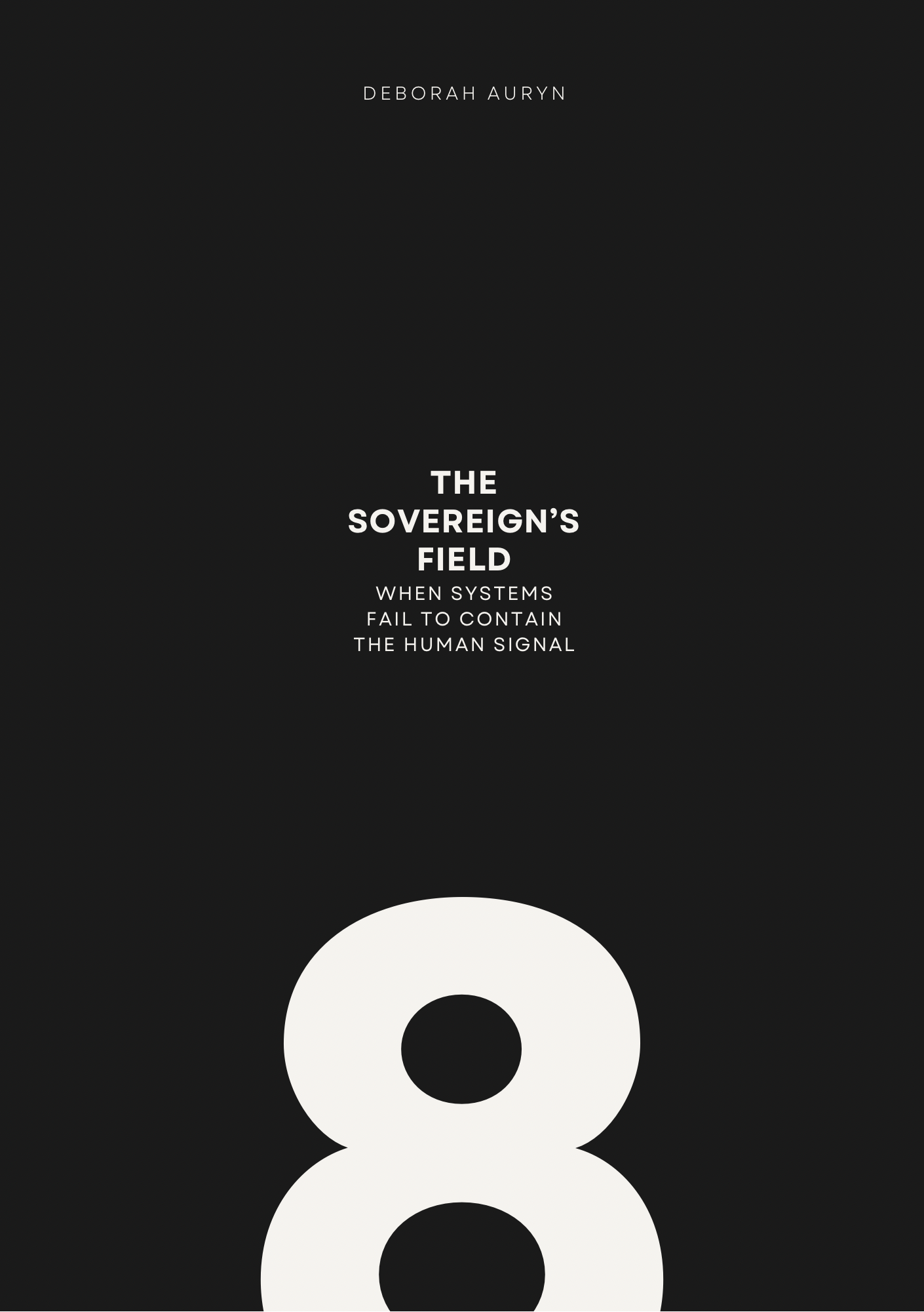
The Sovereign’s Field: When Systems Fail to Contain the Human Signal
€11.00
What if “the field” is not an escape from systems — but evidence of systemic failure?
What if spaciousness appears when imposed structures can no longer successfully organize perception?
And what happens when people interpret that rupture as freedom… without understanding the mechanisms that produced it?
Inside this volume you find:
The difference between sovereignty and withdrawal
Why systems collapse at the level of perception before behavior
How coherence becomes inaccessible inside structurally incoherent environments
The mechanics of suppression, over-adaptation, and perceptual distortion
Why most modern “alignment” frameworks fail under pressure
Boundary integrity as feedback regulation, not performance
The hidden cost of optimization-based communication
Why people mistake silence for transcendence
The relationship between agency, consequence, and behavioral consistency
How systems train humans away from perceiving reality directly
A coherent system does not require fragmentation in order to function.
And a human being should not have to disappear
in order to remain intelligible inside reality.
That is the threshold this work investigates.
Digital Edition (PDF)
Immediate download upon purchase (non-refundable).
For readers investigating:
systems • agency • coherence • suppression • perception • structural design • feedback dynamics • human livability
Read slowly. Test against lived experience. Retain your own signal.
What if “the field” is not an escape from systems — but evidence of systemic failure?
What if spaciousness appears when imposed structures can no longer successfully organize perception?
And what happens when people interpret that rupture as freedom… without understanding the mechanisms that produced it?
Inside this volume you find:
The difference between sovereignty and withdrawal
Why systems collapse at the level of perception before behavior
How coherence becomes inaccessible inside structurally incoherent environments
The mechanics of suppression, over-adaptation, and perceptual distortion
Why most modern “alignment” frameworks fail under pressure
Boundary integrity as feedback regulation, not performance
The hidden cost of optimization-based communication
Why people mistake silence for transcendence
The relationship between agency, consequence, and behavioral consistency
How systems train humans away from perceiving reality directly
A coherent system does not require fragmentation in order to function.
And a human being should not have to disappear
in order to remain intelligible inside reality.
That is the threshold this work investigates.
Digital Edition (PDF)
Immediate download upon purchase (non-refundable).
For readers investigating:
systems • agency • coherence • suppression • perception • structural design • feedback dynamics • human livability
Read slowly. Test against lived experience. Retain your own signal.