
You Were Never Meant to Adapt to This Much Distortion
There are forms of exhaustion that sleep does not fix.
Because the organism is spending enormous amounts of energy trying to reconcile contradictions it was never designed to hold for long periods of time.
To say one thing while feeling another.
To smile while the nervous system contracts.
To continue participating in systems that reward disconnection and call it maturity.
To suppress instinct repeatedly until self-betrayal becomes indistinguishable from being “functional.”
Most people think distortion only becomes dangerous once it turns catastrophic. A breakdown. Burnout. Illness. Collapse. But the organism registers distortion much earlier than that. Long before the mind consciously understands something is wrong, the body has already begun compensating for it. Tightening. Numbing. Adapting.
And adaptation is often mistaken for health.
A person can become extraordinarily skilled at functioning inside incoherence while slowly losing access to their perception. This is one of the quiet tragedies of modern life: the normalization of conditions the human nervous system experiences as hostile. Not dramatic enough to escape, not nourishing enough to truly live inside.
Children feel this immediately. Many of us did. The sensation that something about the way adults moved through the world felt deeply wrong, even if nobody around us could name it. The pressure to override intuition. The pressure to perform normalcy. The pressure to tolerate environments that quietly harmed us because “that’s just how life works.”
But organisms do not forget what they endure simply because endurance becomes collective.
What fascinates me is how larger systems stabilize themselves through accumulated micro-distortions. A person suppresses exhaustion to keep working. A family suppresses truth to keep functioning. A community suppresses grief to preserve cohesion. A culture suppresses perception to maintain productivity. Eventually the distortion becomes structural, inherited, almost invisible. People begin protecting the very conditions that are harming them because the alternative feels destabilizing.
And so exhaustion becomes identity. Hypervigilance becomes ambition. Emotional numbing becomes professionalism. Dissociation becomes independence.
The nervous system keeps the score long after the conscious mind adapts to the lie.
What we call “awakening” is sometimes nothing more glamorous than the organism refusing further participation in distortion. The body withdrawing cooperation from what the soul can no longer survive inside unchanged.
This is why coherence can initially feel unbearable. Real rest feels foreign after years of survival. Honest connection feels dangerous after a lifetime of performance. Silence feels confrontational once distraction becomes regulation.
Many people assume that if everyone else tolerates something, they should be able to tolerate it too. But collective participation has never been proof of health. Entire civilizations can normalize conditions that slowly fracture perception. History demonstrates this repeatedly.
The deeper question is not whether adaptation is possible. Human beings can adapt to almost anything.
The question is:
What disappears inside us when adaptation becomes chronic self-distortion?
And at what point does the body finally decide the cost is too high?
what happens if you stop adapting?
〰️
what happens if you stop adapting? 〰️
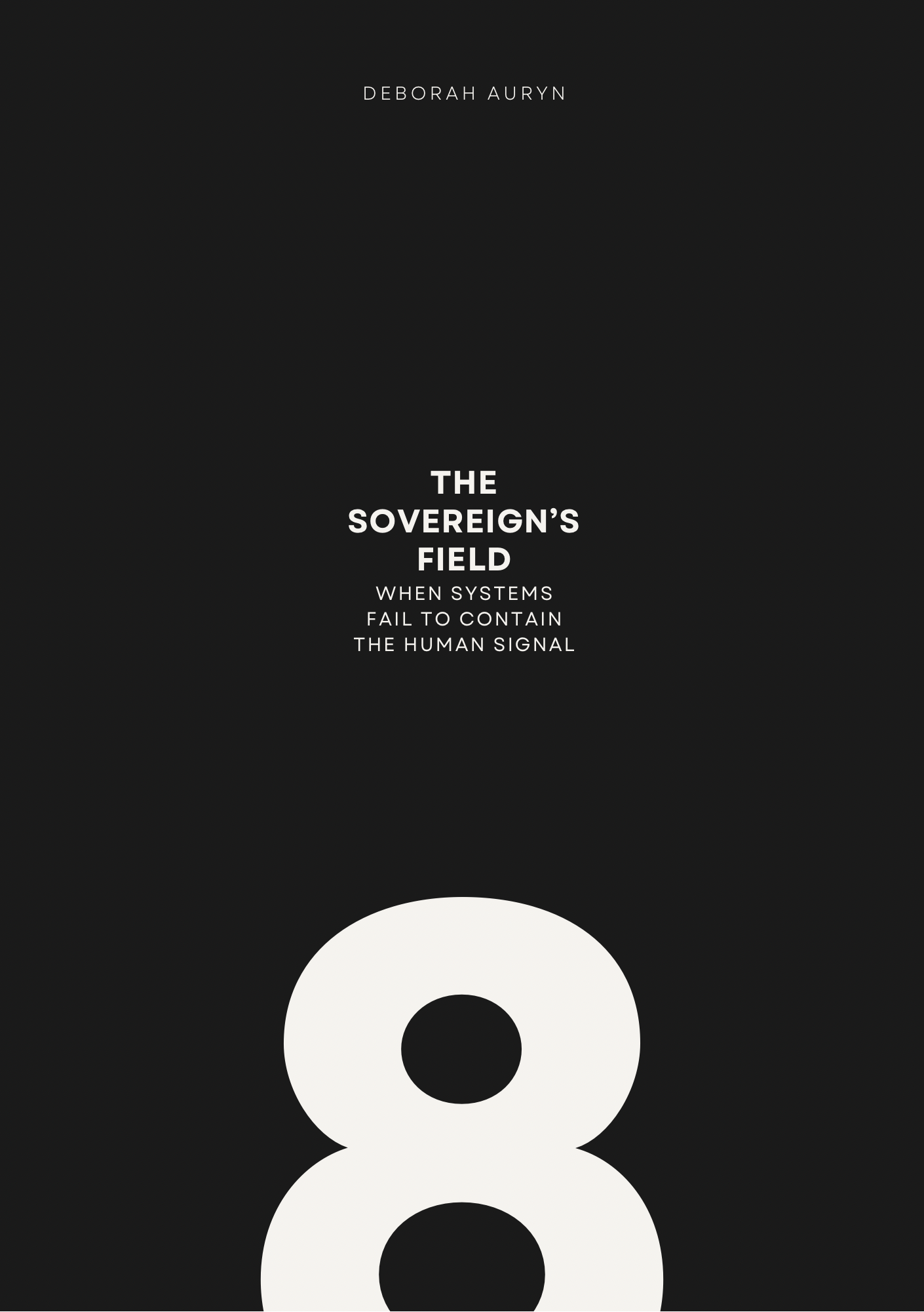
What if “the field” is not an escape from systems — but evidence of systemic failure?
What if spaciousness appears when imposed structures can no longer successfully organize perception?
And what happens when people interpret that rupture as freedom… without understanding the mechanisms that produced it?
Inside this volume you find:
The difference between sovereignty and withdrawal
Why systems collapse at the level of perception before behavior
How coherence becomes inaccessible inside structurally incoherent environments
The mechanics of suppression, over-adaptation, and perceptual distortion
Why most modern “alignment” frameworks fail under pressure
Boundary integrity as feedback regulation, not performance
The hidden cost of optimization-based communication
Why people mistake silence for transcendence
The relationship between agency, consequence, and behavioral consistency
How systems train humans away from perceiving reality directly
A coherent system does not require fragmentation in order to function.
And a human being should not have to disappear
in order to remain intelligible inside reality.
That is the threshold this work investigates.
Digital Edition (PDF)
Immediate download upon purchase (non-refundable).
For readers investigating:
systems • agency • coherence • suppression • perception • structural design • feedback dynamics • human livability
Read slowly. Test against lived experience. Retain your own signal.